management

Effectiveness of Process of Delegation

Effectiveness of Process of Delegation

Effectiveness of Process of Delegation The effectiveness of the process of delegation is crucial for the success of any business enterprise. Effective delegation of authority involves selecting competent subordinates, fostering cooperation, and providing clear explanations of delegated functions and responsibilities. Open communication and minimal interference from superiors ensure that subordinates can perform their tasks efficiently. […]

Effectiveness of Process of Delegation Read More »

Difficulties of Delegation of Authority

Difficulties of Delegation of Authority The difficulties of delegation of authority in a business enterprise are multifaceted. Managers often resist delegating due to a desire for maximum control and fear of losing importance. Additionally, not all managers possess the necessary skills for effective delegation, and the lack of capable subordinates further complicates the process. Concerns

Difficulties of Delegation of Authority Read More »

Importance of Delegation of Authority

Importance of Delegation of Authority The importance of delegation of authority lies in its ability to enhance coordination, reduce administrative burdens, support business growth, develop subordinates, enable specialization, and manage large-scale operations effectively. Delegation of authority in a business enterprise helps in coordinating tasks, reducing the administrative burden on higher authorities, and facilitating business expansion.

Importance of Delegation of Authority Read More »

Delegation of Authority

Delegation of Authority

Meaning of Delegation of Authority In today’s commercial era, a manager or officer can’t control the whole management of the organization alone. That is why officers transfer their work to other subordinates and employees. This transfer of workload to other persons is called Delegation. To each subordinate employee, who is assigned the work, it is

Delegation of Authority Read More »

Scope of Control

Meaning of Control Control refers to such supervision which ensures that all the activities of a business organization are performed according to the predetermined objectives, planning, policies, programs, given directions, and rules of the management. It aims to bring forth the deficiencies and errors of work and to detect the reasons and the persons responsible

Scope of Control Read More »

Scientific Management

Scientific Management The word scientific management is made from two words. The first is scientific, the other is management. Scientific means specialized knowledge on a particular subject, whereas management means establishing coordination between the various factors of production so that maximum production can be done at minimum cost. It is the name of that management

Scientific Management Read More »

Decentralization

Meaning of Decentralization Decentralization is a developed form of delegation. When an executive or a high official delegate gives more than the expected amount of responsibility and rights or powers to his subordinates, it is called Decentralisation. Thus, decentralization is a form of distribution of responsibilities, in which the lower level employees are entrusted with

Decentralization Read More »

Committee Organisation

Committee Organization

Committee Organization A Committee Organization is a type of democratic organization where all the decisions and work are carried out after mutual discussions and majority voting. Similarly, it has a Working Committee which is formed by the heads of different departments of the organization, who put forward the problems of each department in the meetings.

Committee Organization Read More »

Line and Staff Organisation

Line and Staff Organization

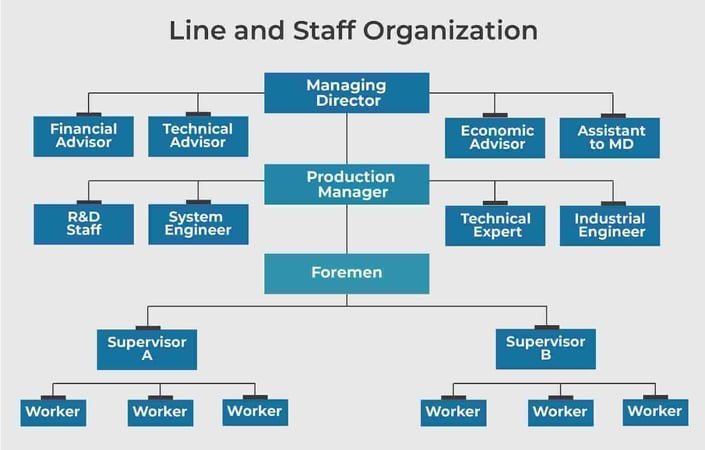
Line and Staff Organization This method was developed to remove the defects of the Line Organization and Functional Organization. Under this system, the work is divided into independent divisions, and responsibility is also divided in a scalar form but a technical specialist is also appointed along with the departmental heads. These specialists only give advice

Line and Staff Organization Read More »

Functional Organisation

Functional Organization

Functional Organization The principle of Functional Organization was developed by F.W. Taylor. He emphasized that under this system one person should be allotted only one job in which he is specialized. This organizational structure is built on the principle that no person can be specialized in all fields. Thus, each person should be given one

Functional Organization Read More »