
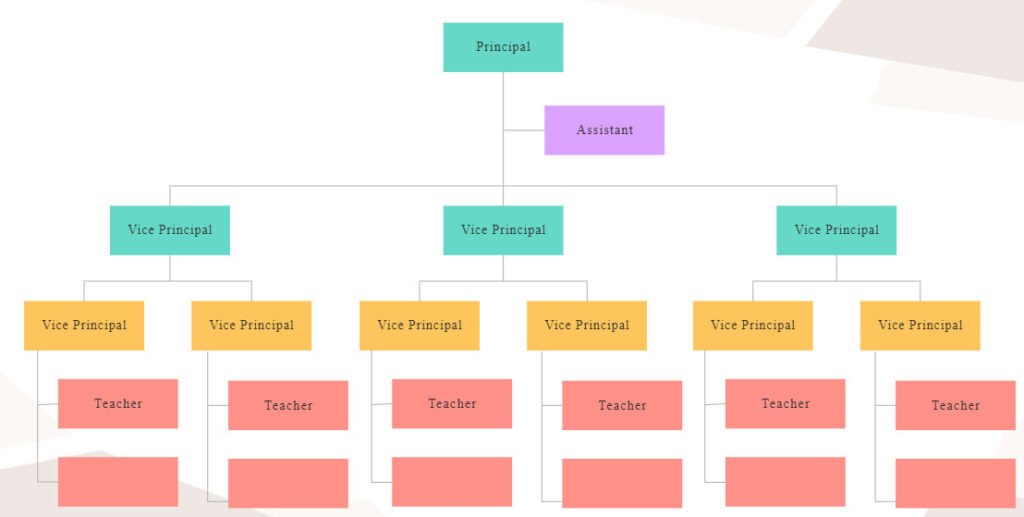
Functional Organization
The principle of Functional Organization was developed by F.W. Taylor. He emphasized that under this system one person should be allotted only one job in which he is specialized. This organizational structure is built on the principle that no person can be specialized in all fields. Thus, each person should be given one job in which he specializes. For this purpose, each activity is divided into sub-processes.
In each sub-process, a supervisor is appointed for direction and information. The supervisor has all the rights relating to that sub-process, e.g., a product specialist is concerned only with the investigation of type g and quality of the product and nothing else. Based on specialization in management, Taylor has suggested eight specialists who give and take directions for fulfilling a particular objective. Four of them are for office work and the remaining four are for factory supervision. The office specialists perform the act of planning and the factory specialists direct and supervise the process of production.
Merits of Functional Organization
-
Increase in Efficiency
Each person employed under a functional organization is a specialist in his job, which increases the efficiency of the organization as a whole.
-
Advantage of Specialisation
The trained personnel always perform their task in a phased manner with the necessary caution and within a specific period. The quality of their work is also equally good.
-
Research
When each specialist is given the related 10b, he gets more opportunities for research and development of new techniques related to his job.
-
Ease in Decision Making
Since each specialist is given the right to make decisions relating to his job without the permission of his superior, the process of decision-making becomes easier. Moreover, decisions are unanimous.
-
Separation of Mental and Manual Jobs
The jobs, under this system, are divided based on mental and manual: work, which enables handling of manual jobs by the untrained staff and mental jobs can be given to the trained and able employees.
Demerits of Functional Organization
-
Difficulty in coordination
Establishing coordination in the work of different specialists is very difficult.
-
Uneconomical
The appointment of several specialized employees and divisions makes this system uneconomical for most organizations.
-
Lack of Discipline
in this kind of organization, a lack of discipline is found. When all the rights and powers regarding each job are given to one person, it becomes, challenging for the higher subordinates to maintain discipline and control, in the organization.
-
Race for Power
Officials under this system are always racing for more power, which negatively affects the employees.
-
Lack of Responsibility
Since each process is divided and distributed among various employees the workers become irresponsible.