
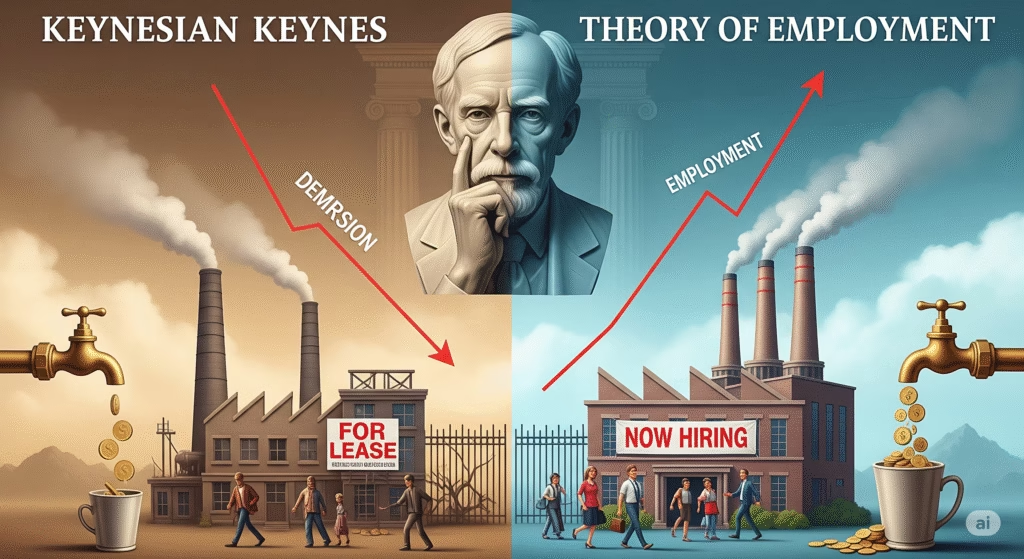
Introduction to Keynesian Theory of Employment

Keynes gave Keynesian Theory in his volume “General Theory of Employment, Interest, and Money”. He not only criticized the Classical Theory of Employment but also analyzed those factors that affect the employment and production level of an economy. Most of the modern economists agree with the concept of Keynes. The Keynesian Theory of Employment is a product of the worldwide depression of 1931-36. Due to this depression, unemployment spread in all independent capitalist economies. Keynes analyzed the situation of unemployment and tried to find the reason and solution to that problem.
>During that time, the theories of British economist John Maynard Keynes—deficit-based, government stimulus spending, and strong regulation of markets—dominated economic policy and thought.
Explanation of the Theory of Employment
“Classical theory of Employment” also analyzed those factors that affect the employment and production level of an economy. Most of the modern economists agree with the concept of Keynes. The Keynesian Theory of Employment is a product of the worldwide depression of 1931-36. This comprehensive examination by Keynes falls under what we categorically refer to as “Keynesian Theory.” Due to this depression, unemployment spread in all independent capitalist economies. Keynes analyzed the situation of unemployment and tried to find the reason and solution to that problem.
According to this theory, since the demand for goods and services does not meet the total actual resources that may be utilized, unemployment arises. In the words of Keynes,
The deficiency in effective demand, stops the increase in employment to reach the full employment level.
With an increase in the effective demand of consumers, the resources are utilized in massive quantities. Consequently, the level of employment rises. When people start demanding another product in place of a product temporarily, unemployment would increase due to a fall in total demand. This concept is a central topic in what is known as “Theory of Keynesian Economics.” A permanent fall in demand occurs when instead of making expenditures on consumer goods, people try to save most part of their incomes. A deficiency in demand for goods and services in one sector of society is not compensated by an increase in demand for goods and services in another sector. As a result, total demand declines.
Deficiency, Demand, and Employment – Keynesian Theory
If the desire to save from their income is more than the desire for substitution expenditure, a reverse relationship develops. Consequently, demand and employment increase. When the desire to save is lesser than the substitution expenditure in the society, demand and employment increase. This dynamic proves foundational in the key aspects of the Keynesian Theory regarding economic growth.
In Keynes’s view, the level of employment of any country depends on its effective demand. Effective demand depends on the total supply of production and the total demand. The total supply of production depends on total investment and total consumption. The amount of consumption is affected by the tendency for consumption and the size of national income. As the income of a person increases, his tendency to consume comparatively reduces. On the other hand, it depends on the amount of investment, the rate of interest, and mostly on the marginal efficiency of capital. In the money market, the demand for capital shall be more even during the period of high rates of interest. This remains true if in view of the investors, capital is more efficient. The marginal efficiency of capital depends on the substitution cost and the anticipated profits.
Reasons for the Spreading of Unemployment
According to Keynes, the three main reasons for the spreading of unemployment are:
- Lack of effective demand
- Deficiency of outlay on consumption
- Deficiency of investment
Read about Unemployment in India.
The Role of Government in Keynesian Theory
While the Classical Theory believed that the economy would naturally self-correct, Keynes argued that this was not always the case. This was especially true during a severe economic downturn like the Great Depression. He introduced the revolutionary idea that the government should play an active role in managing the economy.
According to Keynes, when there is a deficiency in effective demand, private spending (consumption and investment) is insufficient to maintain full employment. In such a situation, the government must step in to fill this gap. Keynes advocated for policies that would increase government spending and reduce taxes. These measures would inject money into the economy, directly boosting demand for goods and services.
This concept is known as fiscal policy. For example, a government might launch a large-scale infrastructure project, such as building roads or bridges. This action would create jobs, and the workers would then have income to spend, further increasing consumption. This creates a “multiplier effect,” where every dollar the government spends generates more than a dollar’s worth of economic activity.
Keynes’s ideas fundamentally changed the way economists and policymakers viewed the relationship between the government and the economy. They provided a theoretical basis for government intervention, suggesting that public spending could be a powerful tool to combat unemployment and stabilize a faltering economy. His theories paved the way for the mixed economies we see today, where both the private sector and government play crucial roles.
Good explanation about Keynesian Theory of Employment.
Thanks